- Home
- Our Story
The Fire Sky Journey.
Like most people, I was first attracted to Ankole by what I could see.
What sits behind the animal?
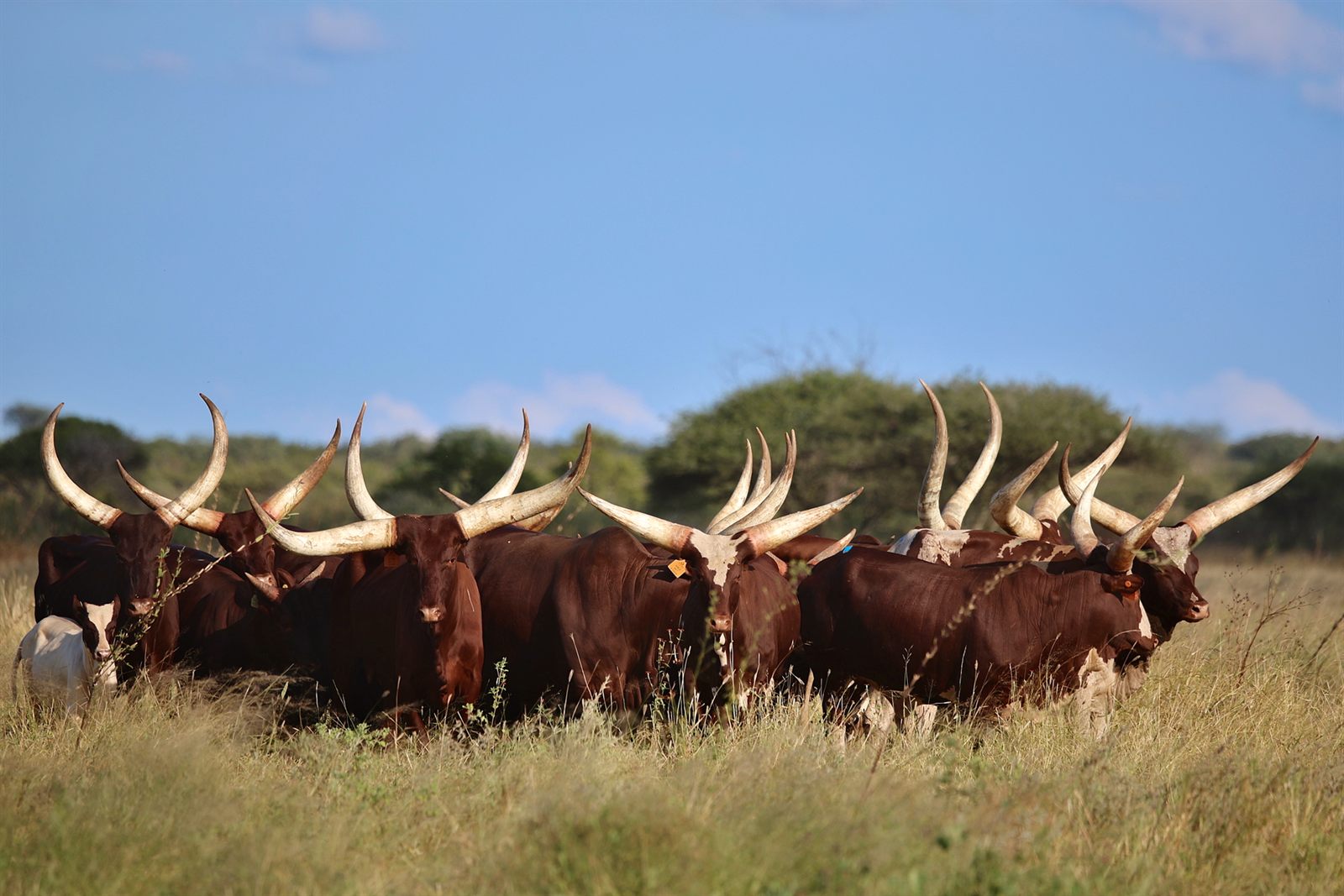
The horns. The colours. The presence. There is something about a great Ankole that makes you stop and look.
But the longer I spent with these cattle, the more interested I became in what I couldn’t see.
What genetics sit behind this animal? Where did they come from? Which foundational cow is buried three or four generations back? What did the sire contribute? Why did one mating produce something exceptional while another, between two equally impressive animals, produced something fairly ordinary?
That became the real fascination for me.
And it is ultimately what Fire Sky is about.
It starts with Uganda.
South Africa’s Ankole story begins with a relatively small foundation of Ugandan genetics.
Those original genetics gave us some extraordinary cattle. But over time we began to understand something important: the number of animals in a herd and the number of genuinely different genetic options available to a breeder are not the same thing.
Some foundational lines reproduced prolifically. Others hardly reproduced at all. Some became dominant. Others became increasingly scarce.
The result is that today’s South African Ankole population may contain many animals, but the genetic architecture underneath them remains relatively concentrated.
Once you understand that, you start looking at an Ankole very differently.
You stop seeing just the cow.
You start seeing the animals behind the cow.
At Fire Sky we have females carrying important foundational lines including A4, A5, A9, A10, A17, A18, A21, A26, A33 and A34, combined in different ways with the original bull lines. Some are direct descendants of those foundational animals; in a few cases we have been able to bring original genetics back into the herd through embryos frozen for many years.
That genetic architecture became the starting point for how we built Fire Sky.
We started with the females.
Our first priority was not to build the biggest herd.
It was to acquire some of the best proven female genetics we could find.
That distinction matters.
A great cow is more than a beautiful animal with spectacular horns. I want fertility. Structure. Femininity. Adaptability. Temperament. Proven ancestry. And, yes, trophy remains part of what makes Ankole extraordinary.
But above all, I want to understand what genetics she carries and what those genetics might allow us to do next.
That is why females such as Kyasha became so important to us. At over 18 years old she remains a prolific embryo donor, and her A21 maternal line combined with BA1 has been propagated through daughters such as Dyana and through her Maximus daughters Kyma, Coco and Cortado. Eve gave us something different again: BA3 directly over the foundational A26 cow, from an embryo that had been frozen for 16 years.
These are not simply cattle we collected.
They became the genetic building blocks of the herd.
Then came the bulls.
Once you own exceptional females, the question changes.
What do you put over them?
Every female already carries the genetic influence of the bulls behind her. The next sire therefore doesn’t simply produce a calf. He changes the genetic architecture of the next generation.
We initially focused on bulls that could enhance the characteristics of the animal as a whole — frame, structure, masculinity, adaptability and performance — without ignoring trophy.
Zeus and Dyambo Junior became particularly important to that phase.
Zeus brought tremendous mass, masculine characteristics and adaptation to our Bushveld environment. Dyambo Junior brought the genetics of the iconic Dyambo, but importantly also a powerful contribution through his dam. Both became part of our attempt to breed better cattle, not simply bigger horns.
At the same time we continued to access some of the marquee genetics in the South African industry. Maximus and Cumulus feature prominently in our herd, alongside genetics from bulls such as Uganda and other leading sires. Our females today show how these combinations have accumulated across generations.
We travelled, bought bulls, used semen, evaluated the results and kept learning. Over four years we accumulated more than 20 bulls and ultimately selected only four for our future breeding programme. Our young bulls are tested and evaluated, and we use sexed semen produced through Ramsem.
The principle is simple:
The famous bull is not necessarily the right bull.
The right bull is the one that complements the cow standing in front of him.
The mating is the real decision.
That is where breeding becomes fascinating.
Kyasha brings A21 through her dam. Maximus brings the prolific A26 line. Their daughters Kyma, Coco and Cortado therefore become much more interesting than simply being daughters of two famous animals. They represent a deliberate combination of important genetics.
Or look at Maxi and Nutmeg, where Maximus and his A26 influence were combined with the scarce A4 female line.
Or Mosi, where the genetics represent a blend of all three original bull bloodlines together with A13, A15 and A18.
These combinations are what interest us.
Sometimes we line breed to reinforce something we value.
Sometimes we cross established South African lines to broaden the combination.
And increasingly, we are looking to outbreeding.
Because when the national genetic foundation is relatively limited, genetic distance matters.
And then Uganda opened the door again.
Nearly two decades after the original foundational genetics, a new opportunity arrived.
New Ugandan genetics entered South Africa via Kenya.
For anyone serious about the long-term future of South African Ankole, the benefit is obvious: genetics unrelated to much of what we have been working with give us an opportunity to broaden the genetic pool.
Fire Sky acquired two of the first young bulls from these newly imported genetics, both born in 2024.
We named them Novus and NextGen.
The names say something about what they represent to us.
Novus combines KBE100503 and KE100701. NextGen combines KBE100506 and KE100729. They give us something particularly valuable: the opportunity to put new, unrelated genetics over some of the best established South African female genetics we have spent years assembling.
We are now beginning to do exactly that.
But this is where I think we need some humility.
We are back at the beginning.
New genetics are exciting.
But new does not automatically mean better.
In many ways we are back where South African Ankole breeders were when the original Ugandan genetics first arrived.
We can study the pedigrees.
We can evaluate the bulls.
We can look at their structure, temperament, horns and growth.
We can carefully choose which South African females to put them over.
But we don’t yet know what the results will be.
And we certainly don’t yet know which of these new bloodlines will become the important ones.
That will take time.
It will take calves.
Then more calves.
It will take daughters becoming cows.
It will take fertility records.
It will take progeny.
And it will take breeders being prepared to study what actually happened rather than simply confirming what we hoped would happen.
That, to me, is one of the most exciting parts of the next chapter.
The next great South African Ankole bloodline may already exist.
We just don’t know which one it is yet.
That is why records matter.
At Fire Sky we keep meticulous breeding records because memory and enthusiasm are poor substitutes for evidence. We have used our embryo programme to build detailed fertility knowledge around our females, and we trace our breeding animals back through their bloodlines.
Over time, the progeny tell you whether your theory was right.
A great-looking young bull is potential.
A great pedigree is potential.
A spectacular heifer is potential.
Only generations turn potential into a proven bloodline.
That is why we increasingly see Fire Sky not simply as a herd of cattle, but as a genetic architecture that we are building over time.
We are custodians before we are owners.
None of us owns these genetics forever.
We inherited an extraordinary genetic heritage from Uganda. South African breeders before us preserved and developed it. We have been fortunate enough to acquire some of its best expressions.
Our job now is to decide what we do with it.
Some genetics should be reinforced.
Some should be crossed.
Some scarce lines need to be preserved.
Some combinations will work.
Others won’t.
And the new Ugandan genetics give us the opportunity to open the genetic architecture again rather than continually breeding within an increasingly familiar pool.
That is why I think of Fire Sky increasingly in terms of five words:
Understand where the genetics came from.
Choose the animals worth building with.
Match genetics deliberately rather than simply mating famous animals.
Let fertility, performance and progeny tell us whether we were right.
Make sure valuable genetics remain available to the generations that follow us.
That is the journey we are on.
From Uganda’s foundational genetics, through nearly two decades of South African breeding, to a new injection of unrelated Ugandan bloodlines and the next generation now being conceived at Fire Sky.
We don’t know exactly where that journey will lead.
If we did, breeding wouldn’t be nearly as interesting.
But we do know what we are trying to do.
Understand what we inherited.
Be deliberate about what we combine.
Study what we produce.
And leave the next generation of Ankole breeders with better genetic choices than we inherited ourselves.
That, for me, is what being a genetic custodian means.
The cattle may capture your eye. The genetic architecture behind them is what fascinates us.